
What a Custom Jewelry Manufacturer Actually Does, Step by Step
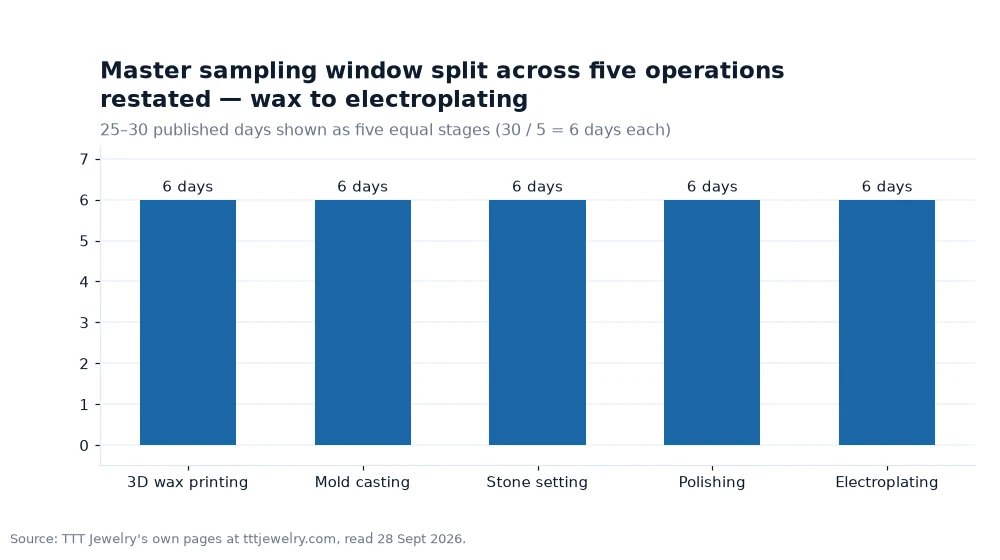
Master sampling at TTT Jewelry breaks into five bench operations of roughly six days each, which totals 30 days — the top of the 25–30 day window the company publishes. The 3D CAD file that starts the job takes under 48 hours, so the drawing is not the slow part. Knowing where the other weeks sit is what separates a workable launch date from an optimistic one.
Key takeaways
- 3D CAD is quoted at under 48 hours, or 6.7–8% of a 25–30 day sampling window.
- Sampling is five operations — wax printing, mould casting, stone setting, polishing and electroplating — at about six days each.
- Bulk production runs 3–4 weeks, meaning 21–28 days after the sample is approved.
- The minimum order is 50 pcs per design in 925 sterling silver and 100 pcs in artisan eco-brass.
The 48-hour file is a decision, not a delay
Ask for a quotation and the reply can land within a day. Ask for a sample and the calendar stretches by a month. The gap is not administrative. The CAD stage settles what a photograph cannot: shank thickness, the seat beneath a stone, whether a hinge is cast in one piece or built from findings, and where a hallmark can sit without weakening a band. TTT Jewelry quotes under 48 hours for the 3D model plus realistic renderings, and the renderings do the real work — they let a buyer judge proportion in pixels before any metal is cut.
Approval is therefore a commitment rather than a formality. Change the stone size or the band width afterwards and the model reopens, which sends the job back to wax printing. That is why a factory asks for a decision on the render rather than on the photograph that inspired it. It is also why two buyers with similar designs can end up six days apart on delivery: one signed off the model, the other asked for a fourth revision of the prong profile.
Five operations, one sampling window
Between an approved model and a sample in hand sits a sequence that buyers compress into a single word. It is five operations, and each has its own failure mode. Wax printing turns the file into a pattern; mould casting replaces the pattern with metal; stone setting cuts the seats and closes the prongs; polishing removes casting texture without rounding a corner; electroplating adds colour and, on silver and brass, an anti-tarnish topcoat. A custom jewelry manufacturer that quotes one sampling number is adding those steps together, not skipping them, and the order matters — a stone set before the casting is cleaned is a stone set twice.
| Stage | What leaves the bench | Published window |
|---|---|---|
| Concept and CAD | Dimensioned drawing and renderings | Under 48 hours |
| Wax printing and mould casting | Metal master with sprues cut | About 6 days |
| Stone setting | Set sample with prongs closed | About 6 days |
| Polishing | Gloss finish with edges intact | About 6 days |
| Electroplating | Plated sample with topcoat | About 6 days |
| Bulk production and QC | Inspected units in packed cartons | 3–4 weeks |
Read the table as two clocks rather than six rows. The top row is a drawing exercise measured in hours; the four middle rows are bench labour measured in days; the last row is a factory run measured in weeks. A buyer who needs a sample for a trade show should count from the middle rows, because no amount of chasing compresses a plating bath. The published 25–30 day window already contains a normal amount of handling. It does not contain a redesign. A sample approved on day 30 still needs 21 days of production before the first carton is packed, so a bench decision taken in week one is already spending the launch date.
Where an order quietly loses a week
Delay usually arrives as a late decision rather than slow hands. Three patterns repeat. A tech pack gives a stone in millimetres but not in carats, so the seat is redrawn. A buyer approves a render, then asks for a band 0.4 mm thinner after seeing the sample, which reopens the model. A plating colour is matched to a phone photograph instead of a physical reference, so the sample returns in the wrong tone.
Suppliers working as an OEM/ODM jewelry manufacturer can absorb part of this because development is inside the service; a strict build-to-file arrangement cannot. Send a physical reference — a competitor's piece, a metal chip, a stone parcel — with the first brief, not the third revision. One parcel in the post can remove a six-day polishing pass from the calendar.
What the brand owns at the end
Ownership is settled before the first mould is cut. TTT Jewelry states 100% NDA cover and that designs stay exclusive to the brand: moulds, CAD files and the collection are not resold or shown elsewhere. For a label building a signature shape, that clause carries more weight than a small gap in unit cost, because a mould that moves between clients turns a design into a commodity.
The same offer covers hallmarks — S925, 316L, 18KGP — applied by laser engraving, and packaging from foil-stamped boxes to barcode labels. Final QC is described as 100% inspection, which means every piece is handled rather than a sample pulled from the batch. In practice that is the last chance to catch a prong that closed short or a plating fault on the inside of a clasp, where a customer will feel it before they see it.
Worked example
Take the 30-day sample apart. Five operations at six days each: 5 × 6 = 30 days, which is 100% of the upper bound of the published 25–30 day window and 120% of the lower bound (30 ÷ 25 = 1.2). The CAD file adds 48 hours, or 2 days, so a brief reaches an approved sample in about 32 days. Bulk production then runs 21–28 days, putting the full route at 2 + 30 + 28 = 60 days at the slow end and 2 + 25 + 21 = 48 days at the fast end. Each bench operation also absorbs 6 ÷ 30 = 20% of the sampling calendar, so one extra polish pass is not a small favour; it is a fifth of the window.
Frequently asked questions
How long does an order take from CAD to delivery?
TTT Jewelry publishes under 48 hours for 3D CAD, 25–30 days for master sampling and 3–4 weeks for mass production. Added together, that is 48–60 days, or roughly seven to nine weeks.
What is the minimum order for a first design?
50 pcs per design in 925 sterling silver, 100 pcs per design in artisan eco-brass and 100+ pcs per design in stainless steel.
Who keeps the mould after production?
The brand does. TTT Jewelry states 100% NDA and that moulds, CAD files and the collection are not resold or shown to other clients.
Reading the schedule before you commit
Three questions turn a quoted lead time into a plan: which operations the sampling window covers, what a single revision does to the calendar, and when the production clock starts. The published sequence answers the first two — five operations, 25–30 days, and a restart at wax printing if the model changes. Buyers assembling a seasonal range often use the custom jewelry wholesale route, where the same bench work runs on an existing model and the front end is shorter. Either way the arithmetic is blunt: 48 hours of CAD, a month of sampling and a month of production is a nine-week decision, not a two-week one.
Source note: figures come from the manufacturer's own website (tttjewelry.com), read 28 Sept 2026.[1]