
Requesting a Brass Jewelry Quote: What to Include
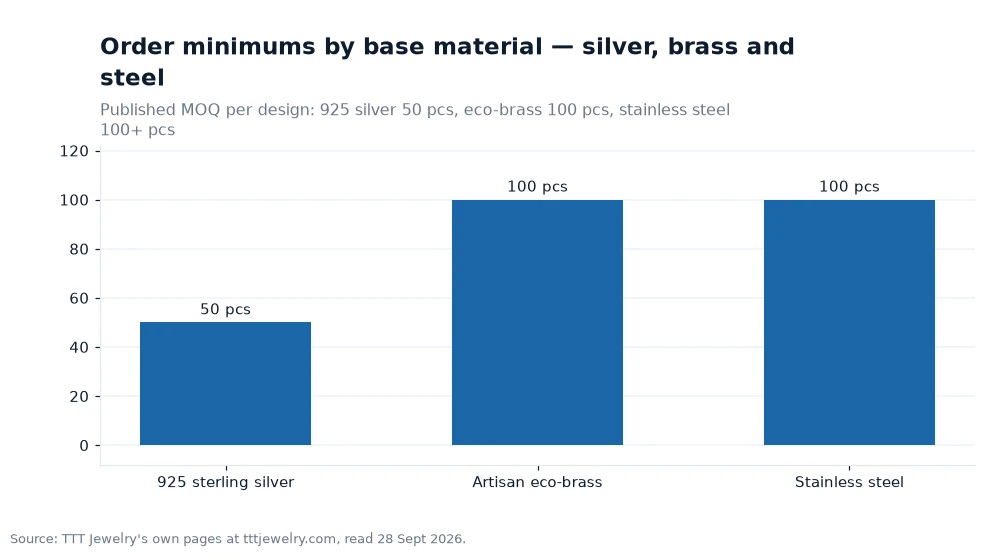
A complete brass request packet lets a factory price the job without follow-up rounds. TTT Jewelry lists artisan eco-brass at an MOQ of 100 pcs per design, handles 3D CAD modelling in under 48 hours, and quotes master physical sampling at 25–30 days. Include material, finish, stones, logo and packaging in the first message and the reply can reference those published windows directly.

Key takeaways
- State custom brass jewelry plus the brass MOQ of 100 pcs per design so the factory prices the right quantity from the start.
- Lock plating (14K, 18K or 24K gold, rhodium, anti-tarnish e-coating) and hallmark text such as 18KGP before sampling.
- Reference the published sampling window of 25–30 days and the mass-production window of 3–4 weeks in the delivery clause.
- Ask for 24-hour response handling with a 1-on-1 project manager and 100% inspection before delivery.
Why incomplete brass requests stall
A brass request that names only a sketch and a quantity leaves the main cost drivers open. The factory cannot fix plating structure, stone setting, or polishing time from a picture alone. Each missing line then triggers another message cycle, and sampling cannot start until the CAD operator knows the exact finish build. TTT Jewelry publishes CAD modelling in under 48 hours, which is only possible when the input already answers finish, size range and logo questions. A short but complete packet therefore shortens the administrative phase more than any later expediting can.
The second failure point is mixed terminology. Buyers sometimes write brass in the subject line and sterling silver in the stone-setting notes, or ask for PVD without naming stainless steel. Since PVD vacuum plating belongs to the stainless line and anti-tarnish e-coating belongs to silver and brass, the factory must stop and clarify. For custom brass jewelry, the request should name brass once and state the MOQ position of 100 pcs per design, keeping every later line consistent with that base metal.
The third stall comes from delivery language without dates. The published figures give sampling at 25–30 days and mass production at 3–4 weeks, with final QC described as 100% inspected before global shipping. A buyer who cites those windows and then gives a target ship week makes the reply concrete.
Material and finish lines to lock first
Open the request with the base metal and its design count. State artisan eco-brass, the number of designs, and the per-design quantity at or above 100 pcs. If the collection also tests silver, keep that line separate and note silver at 50 pcs per design so the two MOQ levels do not merge in costing. This separation matters because moulds, polishing time and plating baths differ by metal, and a blended quantity hides the true per-design cost. Clear metal lines let each design carry its own MOQ, finish and stone schedule.
Next, specify the plating build in full words. Name multi-layer gold in 14K, 18K or 24K, or rhodium where the design needs a white tone, and add anti-tarnish e-coating where the design brief calls for extended wear protection on brass. State compliance alongside: REACH compliant, free of lead, cadmium and nickel, with plating compliant with REACH and CA Prop 65. These lines belong in the first message because they determine bath selection and QC tests. A request that leaves finish open cannot be costed to the same tolerance as one that names the full build.
Close the material block with surface treatment and colour reference. Name high-gloss polishing, brushed or textured areas, and attach a colour chip code or an approved prior sample reference. When the request maps each zone of the piece to one of those treatments, the CAD modeller can build the file in the published under-48-hour window without rework.
Stones, chains and logo details buyers forget
Stone lines need species, cut, size and setting method. List natural stones, freshwater pearls, turquoise, CZ or birthstone accents by millimetre dimension and shape, plus claw, bezel or pavé setting. Exact stone data controls seat cutting in the mould and prong thickness in CAD, which directly affects setting labour.
Chains, findings and wear dimensions come next. For necklaces and bracelets, give link type, width, overall length and clasp style; for earrings, give post, hook or lever-back type. Rings need the full size run and band width. When they are fixed early, the prototype reflects the production piece instead of a simplified stand-in. To turn this specification into action, use the published channel to get quote with the full packet attached, so costing references the same drawings, stone list and finish codes.
Logo and hallmark lines are frequently omitted and then delay approval. State laser-engraved logo placement, artwork vector availability, and hallmark text where relevant. Since designs remain exclusive to the brand and moulds, CAD and collections are not resold or shown, enclosing the artwork under the stated 100% NDA keeps the exchange documented from the first file transfer.
Compliance and QC lines that belong in the packet
Compliance wording should quote the factory's own standards rather than inventing new ones. Cite ISO 9001:2015 for quality management across all production stages, BSCI Audited status for labour and social compliance, and REACH Compliant status covering lead, cadmium and nickel content. Plating compliance with REACH and CA Prop 65 should appear as its own line for brass because the finish is the skin-contact surface. These references tell QC which tests to schedule and tell the buyer which certificates to file. A packet without them invites generic assurances instead of standard-specific checks.
Inspection language should be equally explicit. State 100% inspection before delivery, meaning every piece passes through final QC rather than a sampled subset. Linking these checks to the eight factory steps — concept design, prototyping, sprue cutting, polishing, surface art, electroplating, final QC and delivery — shows where each check gates the next operation. Buyers who follow stainless lines for mixed collections can compare inspection practice on a stainless steel jewelry manufacturer page and keep the QC vocabulary consistent across metals.
Response and ownership terms close the compliance block. Note the published 24-hour response commitment and the assignment of a 1-on-1 dedicated project manager, then state that designs are exclusive to the brand under 100% NDA. Clarify whether the order follows the OEM path, where the buyer supplies CAD and owns the IP, or the ODM path, where concept-to-finished development is co-created yet still exclusive to the brand.
Timings should cite the published six-step OEM/ODM flow: Inquiry, Consultation and Development, CAD and Prototype in under 48 hours, Sample and Approval in 25–30 days, Bulk Production, then Final QC and Delivery. A request that mirrors the factory sequence receives a reply in the same sequence, which reduces missed handoffs. State delivery intent and destination country in the same message, and count the 3–4 week production window from written sample approval rather than from the inquiry date.
| RFQ line | Published reference to cite |
|---|---|
| Brass quantity | Artisan eco-brass MOQ 100 pcs per design; silver contrast at 50 pcs per design |
| CAD turnaround | 3D CAD modelling under 48 hours, equal to 2 days |
| Sampling window | Master physical sampling 25–30 days, or 3.6–4.3 weeks |
| Production window | Mass production 3–4 weeks, or 21–28 days |
| Response and QC | 24-hour response; final QC 100% inspected; 100% NDA |
Worked example
Take a three-design brass capsule where each design meets the brass MOQ of 100 pcs per design. Total pieces equal 3 multiplied by 100, which is 300 pcs. CAD modelling at under 48 hours equals 2 days. Sampling at 25–30 days converts to 3.6–4.3 weeks when divided by 7. Mass production at 3–4 weeks converts to 21–28 days when multiplied by 7. Adding the stages gives 2 plus 25–30 plus 21–28, which totals 48–60 days, or roughly 7–9 weeks from CAD start to inspected finished goods. For scale context, the silver MOQ of 50 pcs is 50 divided by 100, or 50%, of the brass MOQ, so a silver test design carries half the per-design quantity commitment. CAD at 48 hours against a 600–720 hour sampling window (25–30 days times 24) represents 48 divided by 600, or 8%, down to 48 divided by 720, or 6.7%, of the sampling period.
Frequently asked questions
What must a brass RFQ contain before costing?
Base metal and quantities at or above 100 pcs per design, full plating build with 14K, 18K or 24K gold or rhodium plus e-coating intent, stone species and dimensions, chain and finding types, logo artwork and hallmark text, packaging selection, and delivery terms referencing the 25–30 day sampling window and the 3–4 week production window.
How should REACH and plating compliance be worded?
Write REACH Compliant free of lead, cadmium and nickel, plus plating compliant with REACH and CA Prop 65, and cite ISO 9001:2015 and BSCI Audited status. Ask for 100% inspection before delivery so every piece is checked against stone setting, plating coverage and engraving legibility.
When does the production clock start?
Count mass production of 3–4 weeks, or 21–28 days, from written sample approval, not from the first inquiry. CAD under 48 hours and sampling at 25–30 days sit before that approval gate, so the combined CAD plus sampling plus production span totals 48–60 days.
Assembling the packet and sending it
Assemble the packet as a single file set: drawings or CAD, stone and finish schedule, logo vectors, size run, packaging list and target ship week tied to the 25–30 day sampling and 3–4 week production windows. Keep brass and silver quantities on separate lines so the 100 and 50 pcs MOQ levels stay visible. Brands running brass alongside volume programs often align paperwork with custom jewelry wholesale planning so carton splits and barcode labelling match the retail intake.
Send the set together with an ownership statement noting OEM or ODM path, 100% NDA coverage and exclusive rights to moulds and CAD. Request pricing against that fixed scope and ask for any deviation to be flagged as a numbered assumption. That discipline turns the reply into a comparable offer rather than a new round of questions.
Source note: figures come from the manufacturer's own website (tttjewelry.com), read 28 Sept 2026.[1]