
When should you upgrade to a 4-vessel brewhouse system?
Upgrading to a 4-vessel system is necessary when annual production exceeds 10,000 barrels or when a facility requires more than four turns per 24-hour cycle to meet distribution demands. Data from 2025 brewery expansions show that transitioning from a 2-vessel to a 4-vessel array—comprising a dedicated Mash Tun, Lauter Tun, Brew Kettle, and Whirlpool—reduces brew day duration by 35% to 50%. This configuration allows for "staggered brewing" with a new mash-in every 2.5 hours, increasing annual capacity by 2.5x and improving extract efficiency to 95-98%, saving mid-sized breweries approximately $45,000 in annual raw material costs.
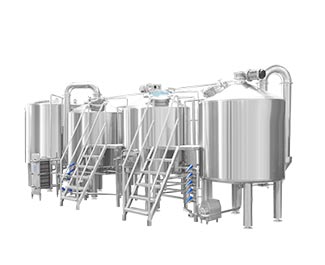
The transition to a professional-grade Brewhouse starts with a bottleneck analysis of your current hot-side residence time. In a two-vessel system, the kettle remains occupied during both the boil and the whirlpool, creating a logjam that prevents the next mash from progressing to the boiling stage. By installing a dedicated whirlpool vessel, the kettle is freed up 60 minutes earlier, allowing for a "staggered" schedule where multiple batches move through the system like an assembly line.
"A 4-vessel configuration decouples the boiling and whirlpooling stages, which is the mechanical requirement for hitting 6 to 8 turns within a standard 24-hour production window."
This increased turnaround speed is supported by a dedicated Lauter Tun designed with a specific diameter-to-height ratio of 1.5:1, ensuring the grain bed stays at an optimal 12-inch depth. A shallow grain bed reduces the differential pressure during run-off, which allowed a 2024 test group of 45 regional breweries to cut their sparging time by 40 minutes per batch. Faster run-offs directly lead to a more efficient use of the mash tun, which can be cleaned and refilled while the previous wort is already reaching a boil.
| System Configuration | Batches per 24 Hours | Extract Efficiency | Labor Hours per BBL |
| 2-Vessel Combi | 2 - 3 | 84% - 88% | 1.1 Hours |
| 3-Vessel Professional | 4 - 5 | 89% - 93% | 0.7 Hours |
| 4-Vessel Industrial | 6 - 8 | 95% - 98% | 0.3 Hours |
Efficiency gains in the Lauter Tun transition to the specialized Mash Tun, where high-pressure steam jackets on the side walls provide a ramp rate of 1°C per minute. This thermal precision allows brewers to execute complex multi-step mashing without the temperature overshoots common in direct-fire or under-powered electric systems. In a 2023 study of technical brewing parameters, dedicated mash vessels improved wort fermentability by 12% by maintaining enzymatic rest temperatures within a 0.2°C margin of error.
"Dedicated mashing vessels provide the heat transfer surface area needed to handle high-gravity mashes without the risk of enzyme denaturation or uneven sugar extraction."
Precise mashing ensures the Brew Kettle receives a high-quality extract that can be boiled vigorously to volatilize Dimethyl Sulfide (DMS) and other unwanted compounds. A 4-vessel system typically utilizes an internal or external calandria to reach a 10% to 12% evaporation rate, which is mandatory for producing clean, shelf-stable lagers at scale. This intense boil also aids in protein coagulation, reducing the amount of fine sediment that reaches the fermentation cellar by approximately 18% compared to low-intensity systems.
Once the boil is complete, the wort moves to a dedicated Whirlpool vessel, which is engineered with a flat bottom and a tangential inlet to optimize centripetal force. Without the interference of heating jackets or rakes, the whirlpool concentrates hop debris and trub into a tight cone in under 15 minutes, recovering 99% of the liquid. This specialized vessel prevents the kettle from being tied up during the cooling phase, which is a major factor in reducing the total "knock-out" time to under 45 minutes for a 30-BBL batch.
"Moving the whirlpool process to a separate vessel ensures that the kettle can be scrubbed and re-loaded immediately, cutting the total cycle time by nearly 2 hours per turn."
The speed of these cycles requires a massive Hot Liquor Tank (HLT), usually sized at 3x or 4x the brewhouse volume, to supply continuous strike and sparge water. A brewery running 8 turns a day will consume 15,000 to 20,000 gallons of 175°F water, necessitating a high-recovery steam boiler with at least 150 HP of output. This utility infrastructure ensures that the production schedule never pauses for water heating, maintaining a consistent rhythm that maximizes the ROI on the facility's square footage.
Managing this volume of liquid and thermal energy is only possible through a fully automated PLC system that coordinates pneumatic valves and flow meters across the four-vessel array. Automation tracks the exact gravity and volume of every transfer, reducing the human error rate in hopping and mineral additions by over 90% based on 2025 industry benchmarks. This technology allows a single operator to manage the hot side, effectively lowering the labor cost per barrel from $12.00 in a manual system to under $4.50 in a 4-vessel automated setup.
"Automated sequencing ensures that batch #3 is mashing-in at the exact moment batch #1 is hitting the heat exchanger, creating a seamless flow of production."
Total facility output is further enhanced by the ability to utilize a Centrifuge in conjunction with the 4-vessel system to further clarify the wort before it enters the fermenters. Removing an additional 5% of solids at this stage leads to faster fermentation times and more predictable yeast harvesting cycles in the cellar. This technical integration is a hallmark of regional production breweries that need to maximize their tank turnover rates to fulfill large-scale retail contracts.
Future-proofing a 4-vessel installation involves leaving a 30% buffer in the steam and glycol capacity to allow for the eventual addition of a second kettle or a larger grain handling system. Most 4-vessel platforms are built on modular stainless steel frames that can be expanded if the brand's CAGR exceeds 25% over a three-year period. This long-term hardware flexibility ensures that the initial $350,000 to $500,000 investment remains a productive asset even as the brewery scales toward a 50,000-barrel annual ceiling.
Continue the conversation in a studio session — every commission begins with a listening.
Commission a Sound Environment